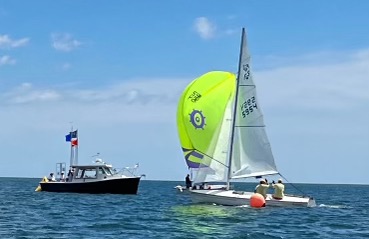
The North American Championships (or “NACs”, as they are commonly called) typically holds a qualifier race series the day before the actual racing begins. This year they decided to ask competitors to “self-designate” the fleet to sail in. We chose to sail in the Challenger Fleet (as opposed to the Championship Fleet) because this was our first NACs. Further, we’ve been practicing and we wanted to get some idea how we’ve improved; recall that we sailed in Challenger in the Midwinters and placed 7th.
The venue was Long Island Sound just south of the Saugatuck River in Westport, CT. The tidal change is about 8 feet here, and this was also our first time sailing in tidal current. Host Cedar Point Yacht Club ensured all competitors had a really great party, regardless of the weather. Indeed, the first day was blown out with winds above 18 knots and gusts hitting 30 knots. Fortunately, the rest of the week was more amenable to a reasonable contest, with winds varying from 3 knots to about 15 knots.
The Challenger Fleet had 16 boats and Championship 34. Championship always started first, and typically were recalled a couple of times each race, necessitating the I then U flags to keep competitors behind the line. However, given that the line length didn’t reset, the Challenger Fleet had no problem clean starting each race. Eight races were scheduled, and seven were completed.
Several learnings will be covered below, but one point deserves real highlights. Kendall apparently loves to swim. He fell off the boat twice on the way back to port , and then fell off the dock, all on the same day. Call him clumsy. Fortunately none of the injuries were significant; he shares a picture of one injury sustained below. It’s hard to notice, but there’s a lump under the scrape. Unfortunately none of the cameras were running during these mishaps.

So, how’d we do? We placed 2nd overall, and took 3 bullets–the picture is of one of them, taken by fellow competitor in Championship, Dave Rink. We had a couple of bad races which knocked us out of the lead, but a significant improvement over Midwinters, and we were able to make the boat go. We’re quite happy with the performance of both the boat and us. Here are the scores:
And, for the Championship Fleet:
here’s our “blooper” video of 3 mishaps at the NACs:
Here are the 5 full-race videos we processed and made publicly available:
Race 1 https://youtu.be/Q8XZqESs8ag
Race 4 https://youtu.be/x6RjKCz2hCk
Race 5 https://youtu.be/SscASrb4o1Q
Race 6 https://youtu.be/_D33Ia32e_o
Race 7 https://youtu.be/_L2Ljuw8n4I
Learnings:
Kendall and I broke apart our jobs, which seemed to work pretty well.
Start: He and I discuss and agree on strategy, including which side of the course is favored and which end of the line is favored. We discuss pros and cons to which end to start on, and then I implement the strategy, maneuvering the boat where we agreed for it to be at the start. Point for improvement: I still need to be more aggressive at the start. I don’t always need to duck and come up under boats; I can start above them.
Upwind: Kendall evaluates wind, fleet and current, choosing A/B and when to tack and cover. At port/starboard crossings he calls ducks and tacks. I make the boat go as fast as possible, maintaining the boat on the edge of stall by constantly adjusting the main, and watching the jib luff telltales for direction, and leech telltale for stall.
Mark rounding: Kendall determines approach and layline, I make the boat go fast, and keep the boat from hitting the mark. In overlap situations, I determine the rounding tactics. (I still hit an off-set mark in one race, a completely unforced error!)
Kite sets: I raise kite, Kendall brings starboard clew around, hands off to me, and I ventilate the kite to get it pulling. Once the kite is up, he raises the board and cleans lines, then adjusts outhaul and heel. POINT FOR IMPROVEMENT: Handing off the sheets can be a point where the transition doesn’t go smoothly, and could lead to problems. Kendall should raise the kite. and I pull it around. That also allows him to see what the boats behind us are doing. Another POINT FOR IMPROVEMENT: Pre-hook the guy before the launch. This makes it easier to keep the kite full once ventilated.
Downwind: I steer and fly the kite, up in lulls and down in puffs (it’s faster for me to adjust course if I feel the pressure), Kendall evaluates wind, fleet and current, choosing A/B and when/how to cover and jibe angles. we both adjust our weight to maintain heel, with windward heel preferred, and rocking/pumping on waves to accelerate the boat. Above 18 knots, Kendall flies the kite.
Kite jibes: I rotate the kite around. Currently I’m steering with my crotch, but that’s not fast; I can and should be able to steer and rotate with my hands. Kendall pre-sets the jib, but occasionally has both jib sheets cleated (IMPROVEMENT OPPORTUNITY). Another POINT FOR IMPROVEMENT: Kendall should use the mainsheet above the block to jibe it across—this prevents the main block from wrapping around the rudder head, and allows him to help roll the boat without coming back in to grab the boom vang and toss the boom across. We did not do this at the regatta; the main block wrapped around the rudder head a lot, so we should try this. Roll-jibes are still a bit challenging. Then Kendall jibes the pole.
Kite douses: As we approach the leeward mark/gate but still about 8 boat lengths out, Kendall drops the board to prep the boat for upwind sailing, and so that if we need time to get the board down we have it. Kendall calls which side to round, I round it without hitting the mark (wide approach, close pass). In this regatta I called the douse, but believe Kendall should call the douse. When the douse happens, the pole is dropped, the kite is collapses by pulling the starboard sheet such that the kite is pulled against the forestay, and Kendall douses on port. I release halyard holding the starboard sheet tight to keep the kite against the forestay, and once the head of the kite is in the turtle, I release the starboard sheet. This allows the kite to be pulled out and around the forestay faster on hoist.
Finish (Downwind): Kendall calls the end to pass by. I steer/jibe to get to that end, making the boat go as fast as possible. (Upwind): Kendall calls the favored end. I steer and make the boat go fast, he calls the tacks and layline.
Our current weaknesses:
- Douses (we shrimped the kite),
- jibes (occasionally the kite collapses),
- Speed (we can get passed downwind),
- jibe angles (Kendall’s call) — the boat does not like to be sailed deep except in high wind.
- A small thing, but it’s crucial: I’m not keeping the tiller extension in front of me. I need to.
Working points:
- Starts on crowded lines.
- Jibes—rotating the kite, rolling the boat.
- Jibes — wrapping the mainsheet block around the rudder head.
Identify a design on the mainsheet/rudder head bail attachment point that will inhibit the mainsheet block from wrapping around the rudder head. (This is something A LOT of people have been struggling with.)
Remove the motor mounts on the stern of the boat to eliminate a snagging hazard.
Our next regatta is in Ephraim, WI. At the time of this post update there are 14 boats registered. We expect around 18-20. This will be our first time at Ephraim, and are very much looking forward to it.
One other comment. The last couple of regattas I did an analysis summary video. I won’t be doing those much any longer. Although they taught us a few things, it seem writing them down is better for retention. Further, the videos were not getting many views.
Thanks for reading!


 Sailing With My Brother
Leave a reply to Matt Madeoy Cancel reply