
Kendall: The results are in and Gadzooks took 9th out of 26 competitors. We’ll keep saying that we aren’t going to make any bold predictions about specific regattas. The Flying Scot fleet has some of the best sailors we’ve met. Our goals are to do our best, to have fun, and keep getting better with each regatta.
We’ll be posting more later this week but for now, a shout out to the winners in the photos below, and a quick video short of our start in race 3 where we finished 7th. Not our best placement but a decent start and a lot of fun. Stay tuned, more coming soon.

Mark Taylor and Michelle Taylor
on 6022 M&M
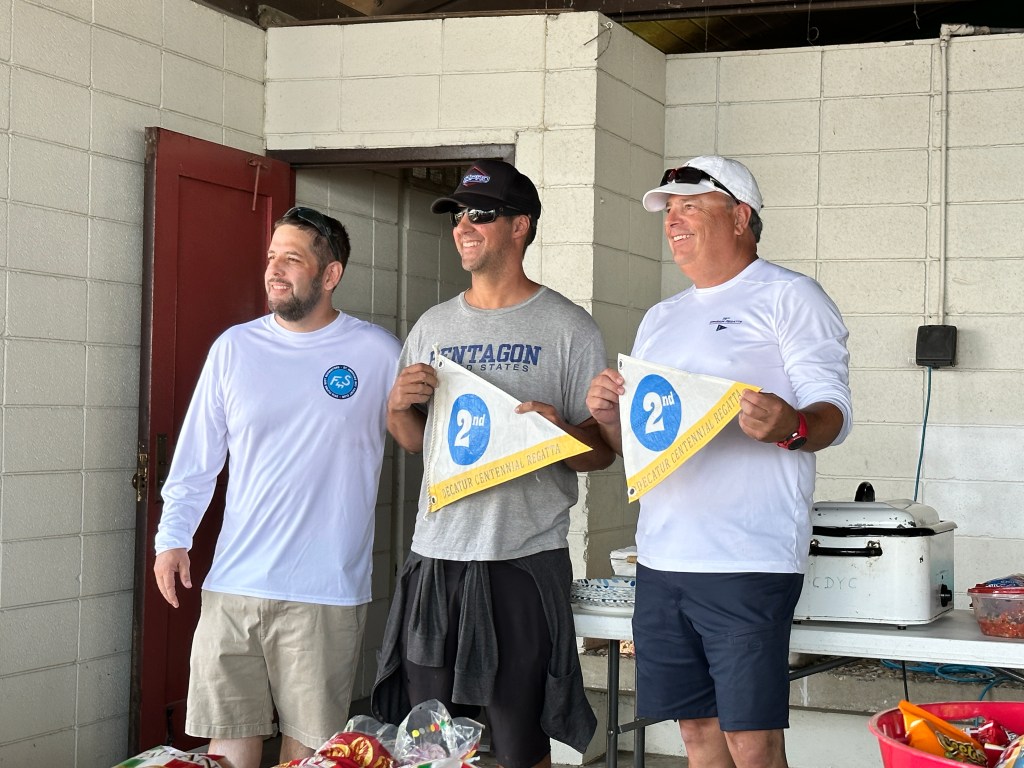
Dave Gorwitz and PJ Buhler
on 6193 Too Many Daves

Jim Crabtree and David Ames
on 6259 Grace
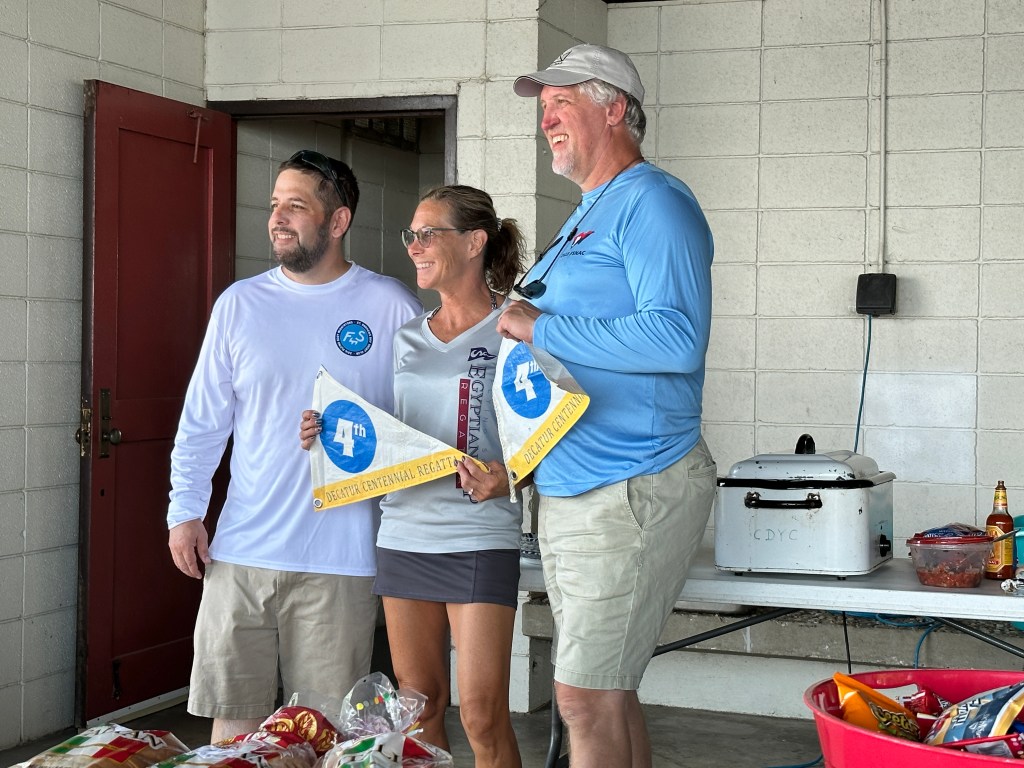
Bruce Kitchen and Lynn Kitchen
on 6086 The Kitchen Sink III
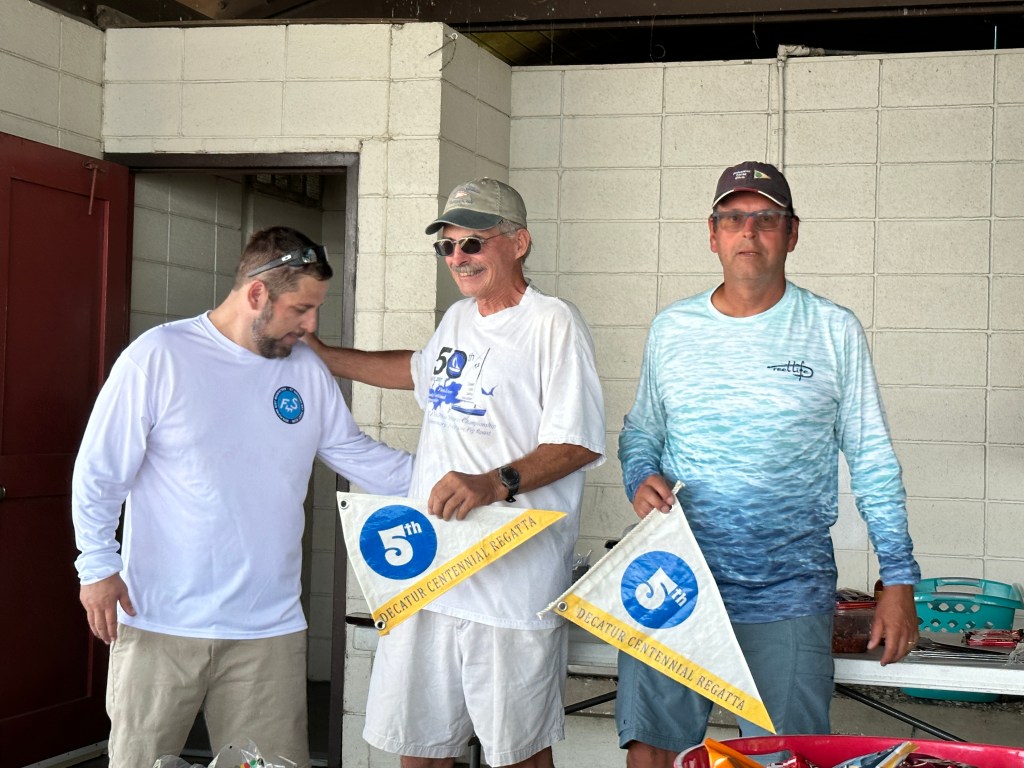
Scott Cline and Mark Mentgen
on 6055 Warpath
Kevin: We sailed on Lake Decatur for a Flying Scot regatta 7/8-9/23. Winds 7/9 were too light to race. Results below. On 7/7/23 David Ames held a seminar on proper sailing and roll-tacking the Scot.
We sailed better but inconsistently in this regatta, scoring 14, 5, 7. When we got good starts, we held reasonably well, but never went up the ladder, only down. Race 1 we had a bad start and we never seemed to get out of the pack. Looking at Bruce Kitchen, for example, he did not have as good a starts as us, but consistently moved up the ladder.
From the Egyptian Cup regatta we had 10 low-hanging fruit items. We managed to pick and handle every one of them. Although in Race 1 we went right and the prevailing shift was right, the left side was heavily favored. We noted that between Races 1 and 2 when we clearly saw the leaders go left. Further, we went to the right side of the leeward gate, which was clearly favored. A good call on our part.
The rig is not yet correct. I have a bit of constant weather helm. But, I watched David Ames set Jim Crabtree’s rig up, and took some notes. While I continue to disagree with ignoring the jib toggle, it’s clear that’s the direction the leaders have gone. Given this, I believe I need to, at this time, emulate the class leaders. That means setting up the rig with a different forestay adjustment plate and a stiff rig. See “Mast Rake” for more details.
We are not sailing flat-flat. The David Ames seminar indicated the ideal heal for the FS is 7 degrees. So, we target 5-7 and spill heavily at 10 to bring the boat back down.
Our nemesis continues to be downwind. We’re really slipping the ladder going downwind. This is likely mostly because we’re not high enough on the launch—we’re letting others go over the top of us. We need to protect our wind by staying high. We’re also struggling to launch the chute probably because of the forestay adjustment plate at our jib tack. The guy hangs on it as I bring it around. We did learn that with me sitting in the back low side, and Kendall standing over the board trunk just ahead of the main sheet block is fast, especially when he watches the chute well and I play the puffs (up in lulls, down in puffs) and we communicate well. He needs to tell me when he has pressure as that will help me identify the small puffs.
We started roll-tacking (after David showed us how) and although we’re not yet proficient, we’re pretty good at it. This helped us not lose any ground upwind to others.
Our jib sheets are too heavy, and our boom vang is not set up quite right (we can’t get the force on it we need to, and the tail is too long). The rig is not exactly right either. So a few tweaks are needed. I ordered new jib sheets (Marlow Excel Fusion 7mm, 21’ red, 21’ blue [they don’t have green]), and jib blocks for a 2:1 purchase. Although some sailors like a continuous jib sheet, tying them together is doable, and I like to have different colors for the different sides.
The trailer has a hub that needs some work. It’s too tight, and the grease is not staying in place. Probably I have a bad seal on the back, although I’m not slinging grease there.
We’re close to winning hardware. We simply need to assemble a consistent series. A 14 will knock us out every time. But a 5/5/7 may be enough to get us in 5th overall.
Results from this regatta:

A few lessons:
- Start with clear air and full speed, even if that means not starting at the favored end. We are struggling to climb the ladder, so it will be better to be near the front with clear air than at the favored end and heavily blanketed. Besides, so far the RC’s have been very good at setting square lines.
- Downwind: Stay high early to protect our wind, come up in the lulls and down the puffs. Communicate when there’s pressure.
- Roll tack. Get better at this.
- Roll gybe. We’ve not really tried it yet with a chute.
- Finish on the favored end. Assuming the line doesn’t move it should be the opposite end of the favored start end. We lost (race 2) one or two boats because we finished in the middle. That also means you need to know where you are on the race course. If it’s a W/L 4 (4x around) keep track! Not as easy as it sounds.
- We are clearly sailing too low downwind. If we’re by the lee, better to heat up and then gybe.
- Whenever there’s an inside overlap on us, we need to take it very wide on the approach. This will allow us to come up on the stern (maybe inside?) of the boat ahead.
- Don’t be afraid to gybe!!!!
- I may be over trimming the main downwind. Video suggests I am, but with a fisheye, it’s hard to tell.
These things with some rig adjustments (mentioned above) should get us even closer to making it in the hardware.
A few shorts below of the regatta.
Good morning Kevin,
Good boat handling fundamentally comes down to three basic elements, using steering, sail trim, and weight placement to turn the boat without losing speed. Sounds easy enough but to gain mastery of your boat handling you will have to use the precise amounts of steering, sail trim, and weight placement at precisely the correct time during your maneuvers which is extremely difficult. If you think about our discussion on roll tacking, a perfect tack comes down to setting the boat up for the tack with the right amount of weather helm. To achieve the correct amount of helm you will have to adjust your weight placement inward in light wind to increase helm. As you begin your tack you will let the tiller go neutral and the boat will head up on its own. At the point where the jib luffs, you will uncleat it but hold it into backwind through the tack. Right at head to wind, you will roll the boat to weather as hard as you can with your crew to assist turning the boat all the way to the new closed hauled course. Once the boat is almost at closed hauled on the new tack you will switch the jib to leeward and ease the main to promote flow in the sails. Once the sails start to build pressure you will move the skipper and crew to weather to flatten and reaccelerate the boat.
Hope this is a good example of breaking it down to the fundamentals.Thanks David.
Email from David Ames

 Sailing With My Brother
Leave a reply to Mast Rake – Sailing With My Brother Cancel reply